In the competitive world of apparel manufacturing, selecting the right GSM (grams per square meter) for heavyweight hoodies can make or break a brand’s product line. As a factory-floor expert with years in the supply chain, I’ve seen countless clothing designers, procurement managers, and brand founders grapple with this choice. GSM measures fabric weight and density, directly influencing hoodie weight and performance. The most common heavyweight options—300 GSM, 400 GSM, and 500 GSM—represent a spectrum from versatile midweight to ultra-premium heavyweight fleece.
But which one aligns with your design positioning, like oversized silhouettes versus slim-fit styles? This in-depth comparison, drawn from production realities, will break down the differences in warmth, drape, structure, and more, providing quantifiable data to guide your procurement decisions. We’ll avoid superficial style commentary and focus on supply chain insights, including costs, MOQs, and manufacturing implications.
Understanding GSM in Heavyweight Hoodies: A Supply Chain Perspective
GSM is the industry standard for quantifying fabric thickness and density in heavyweight fleece used for hoodies. It represents the weight of one square meter of fabric, correlating directly to yarn thickness, weave tightness, and material composition—typically cotton-poly blends for durability. From a manufacturing viewpoint, higher GSM means more raw material input, affecting everything from knitting machine settings to dyeing processes. For instance, producing 500 GSM heavyweight fleece requires denser yarns and specialized looms to prevent defects like uneven brushing.
In 2026, with rising demands for sustainable and premium streetwear, brands are shifting toward higher GSM for perceived quality. According to industry data, hoodies in the 400-500 GSM range now dominate premium segments, offering a balance of hoodie weight and functionality. Lower GSM like 300 is ideal for cost-sensitive lines, but it may compromise on structure for oversized designs.
Let’s visualize the differences in fabric thickness.

This chart illustrates how GSM escalates from 300 (midweight) to 500 (heavyweight), impacting overall hoodie weight.
Core Dimension 1: Warmth and Insulation Properties
Warmth is a primary factor in heavyweight hoodies, determined by the fabric’s ability to trap air within its fibers. From a supply chain angle, this ties to the brushing process—higher GSM allows for deeper fleece piles, enhancing thermal retention.
- 300 GSM: Offers moderate warmth, suitable for transitional seasons. Tests show it retains heat at about 20-25% less efficiency than higher weights due to thinner fleece layers. Ideal for layering without bulk, but in cold climates (below 10°C), it may require additional insulation. Production note: Easier to dye and finish, with lower energy costs in manufacturing.
- 400 GSM: The sweet spot for versatile warmth. It provides 30-40% better insulation than 300 GSM, based on factory thermal conductivity tests. This heavyweight fleece excels in fall/winter collections, trapping body heat effectively for temperatures down to 0°C. Supply chain advantage: Balanced yarn usage minimizes waste, around 5-7% during cutting.
- 500 GSM: Superior warmth for extreme conditions. It can retain up to 50% more heat than 300 GSM, making it premium for winter lines. However, the denser structure increases production time by 15-20% due to slower knitting speeds to avoid yarn breakage.
In procurement, consider your target market’s climate—300 GSM suits milder regions, while 500 GSM commands higher retail prices for perceived coziness.
Core Dimension 2: Drape and Flow Characteristics
Drape refers to how the fabric hangs on the body, crucial for design positioning like oversized vs. fitted hoodies. Lower GSM promotes fluidity, while higher weights offer resistance for structured looks. Manufacturing-wise, drape affects pattern grading and seam allowances.
- 300 GSM: Excellent drape with a soft, flowing fall. It conforms closely to the body, ideal for slim-fit or athletic designs where mobility is key. However, in oversized styles, it may sag, lacking the “hang” for boxy silhouettes. Fabric thickness is around 0.8-1.0 mm, leading to 10-15% higher yield in cutting phases.
- 400 GSM: Balanced drape with moderate stiffness. It flows well but holds shape better than 300 GSM, supporting oversized fits without excessive droop. Thickness: 1.0-1.2 mm. From the factory floor, this GSM reduces seam puckering by 20% in heavyweight fleece production.
- 500 GSM: Minimal drape, emphasizing rigidity. Perfect for structured, oversized hoodies that maintain a bold, architectural profile. Thickness exceeds 1.2 mm, but it can increase fabric consumption by 15-20% per unit due to less flexibility in layouts.
For brands focusing on oversized trends, 400-500 GSM provides the necessary heft to avoid a “limp” appearance.
Let’s see an example of lighter fabric drape.

Core Dimension 3: Structure and Shape Retention
Structure is about the hoodie’s ability to hold its form after washing and wear, vital for brand longevity. Higher GSM correlates with better yarn density, reducing pilling and deformation.
- 300 GSM: Limited structure; it drapes flat and may lose shape after 10-15 washes, with deformation rates up to 5-7%. Suited for budget lines, but requires reinforced seams in production to mitigate sagging.
- 400 GSM: Strong structure with good recovery. Wash tests show only 2-4% shrinkage, making it reliable for repeated use. This GSM is a factory favorite for its ease in patterning oversized cuts without excessive adjustments.
- 500 GSM: Exceptional structure, akin to luxury heavyweight fleece. Deformation is minimal (under 2%), ideal for premium positioning. However, it demands precise cutting to handle the bulk, potentially raising MOQ thresholds.
Brands aiming for durable, high-end hoodies should prioritize 400+ GSM for better consumer reviews on longevity.
Core Dimension 4: Cost Structure and Pricing Implications
From a procurement standpoint, GSM directly impacts unit costs due to material volume. Assume a standard cotton-poly blend; prices vary by supplier but provide a baseline.
- 300 GSM: Lowest cost, ranging $8-12 per unit for bulk orders (MOQ 500-1000 pieces). Material expense is about 30% less than higher weights, with faster production cycles (7-10 days for 1000 units).
- 400 GSM: Mid-range, $12-18 per unit (MOQ 300-800 pieces). Increased yarn costs add 20-30% to raw materials, but economies of scale in heavyweight fleece dyeing keep it competitive.
- 500 GSM: Highest, $18-25 per unit (MOQ 200-600 pieces). Fabric costs rise 40-50% due to denser weaves, plus longer lead times (10-14 days).
These figures exclude customizations like embroidery, which may add $2-5 per unit across all GSM.
Core Dimension 5: Production Cycle and Manufacturing Challenges
Lead times and defects are key supply chain metrics. Higher GSM extends cycles but enhances quality.
- 300 GSM: Shortest cycle (5-7 days for sampling), low defect rates (under 2%). Easy to handle in mass production.
- 400 GSM: Moderate (7-10 days), with 2-3% defects from brushing inconsistencies.
- 500 GSM: Longest (10-12 days), higher risks of uneven density (3-5% defects), requiring skilled operators.
For startups, 300-400 GSM minimizes risks; mature brands can leverage 500 GSM for differentiation.
Core Dimension 6: Durability and Wear Resistance
Durability ties to fiber strength and weave. Lab tests (e.g., Martindale abrasion) show higher GSM withstands more cycles.
- 300 GSM: Fair durability, 10,000-15,000 abrasion cycles. Prone to pilling after 20 washes.
- 400 GSM: Good, 20,000-30,000 cycles. Retains integrity in heavyweight use.
- 500 GSM: Excellent, over 30,000 cycles. Ideal for high-wear environments.
Core Dimension 7: Design Limitations and Compatibility
GSM affects print adaptability and fit options.
- 300 GSM: Versatile for complex prints; suits fitted designs but limits oversized due to poor hold.
- 400 GSM: Broad compatibility; enhances oversized with structure, supports DTG or screen printing.
- 500 GSM: Best for bold, structured looks; may restrict intricate embroidery due to thickness.
View this close-up of midweight fabric.

Is a 400 GSM hoodie warm? – Clothing Manufacturer – Modaknits Apparel
Comparison Summary Table
| Dimension | 300 GSM | 400 GSM | 500 GSM |
|---|---|---|---|
| Warmth | Moderate (20-25% less than 500) | Good (30-40% better than 300) | Superior (50%+ over 300) |
| Drape | Flowing, soft | Balanced, moderate stiffness | Minimal, rigid |
| Structure | Limited, flat | Strong, shape-retaining | Exceptional, premium |
| Cost per Unit | $8-12 | $12-18 | $18-25 |
| MOQ Range | 500-1000 | 300-800 | 200-600 |
| Production Cycle | 5-7 days | 7-10 days | 10-12 days |
| Durability | Fair (10k-15k cycles) | Good (20k-30k) | Excellent (30k+) |
| Best Fit | Fitted/Athletic | Versatile/Oversized | Structured/Oversized |
This table encapsulates the trade-offs, helping procurement teams align with brand goals.
Decision Scenarios: Choosing GSM Based on Design Positioning
To make this actionable, here’s a simple decision tree for hoodie weight selection:
- If your brand focuses on slim-fit or athletic hoodies: Opt for 300 GSM. Its fabric thickness supports mobility without bulk, keeping costs low for entry-level lines.
- For versatile, everyday streetwear: Go with 400 GSM heavyweight fleece. It balances warmth and drape, perfect for mixed collections.
- Premium, oversized designs: Choose 500 GSM. The superior structure elevates perceived value, though factor in higher MOQs.
For growing brands, start with 400 GSM to test markets before scaling to 500.
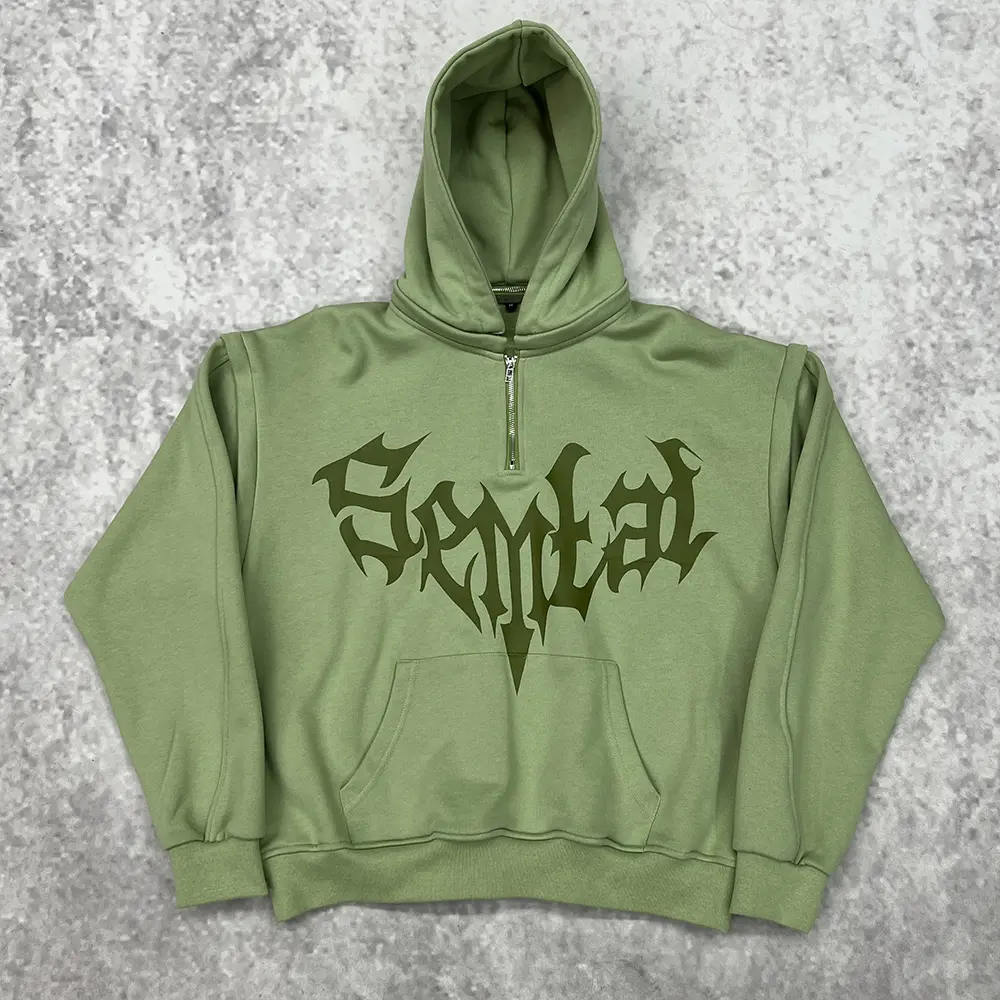
Here’s an example of heavyweight structure.

FAQ: Practical Questions on GSM for Heavyweight Hoodies
Q: How does GSM impact minimum order quantities (MOQ)?
A: Higher GSM like 500 often has lower MOQs (200-600) due to premium positioning, but requires more setup. At Qianshiwear, we flex down to 100 for 400 GSM via inventory sharing.
Q: Can I mix GSM in one order to reduce costs?
A: Yes, but it increases complexity. 300 GSM saves 20-30% vs. 500, ideal for prototyping.
Q: What’s the shrinkage rate difference?
A: 300 GSM shrinks 5-7%, 400 GSM 2-4%, 500 GSM under 2%. Pre-wash fabrics to minimize.
Q: How does GSM affect sustainability?
A: Higher GSM uses more material, but organic blends at 400+ reduce environmental impact through longevity.
Q: Is 400 GSM sufficient for winter hoodies?
A: Absolutely; it provides ample warmth without the bulk of 500 GSM.
Conclusion: The Future of Heavyweight Fleece in 2026
Based on production trends, I boldly predict that by 2027, 400 GSM will become the baseline for premium heavyweight hoodies, as brands prioritize versatile fabric thickness over extremes—balancing cost, warmth, and structure amid rising material prices. This shift, informed by supply chain data, underscores the need for adaptive manufacturing.
Realizing this optimal GSM selection hinges on partnering with a manufacturer that understands not just technical specs, but your brand’s vision. This is where specialists like Qianshiwear excel—as a professional OEM/ODM factory, we leverage advanced knitting tech and sustainable sourcing to deliver custom heavyweight fleece hoodies at competitive MOQs, ensuring superior warmth, drape, and durability that boost your market edge. Explore our solutions at qianshiwear.com for tailored consultations on GSM options.