
The rhinestone hoodie isn’t just a party trend; it’s a high-margin product category with a deceptively complex supply chain. For brand owners and retailers, its surge in popularity represents a significant opportunity, but also a common pitfall: the gap between a visually stunning sample and a commercially viable, durable product. This guide deconstructs the trend from a factory-floor perspective, providing the insights needed to transform sparkle into sustainable sales.
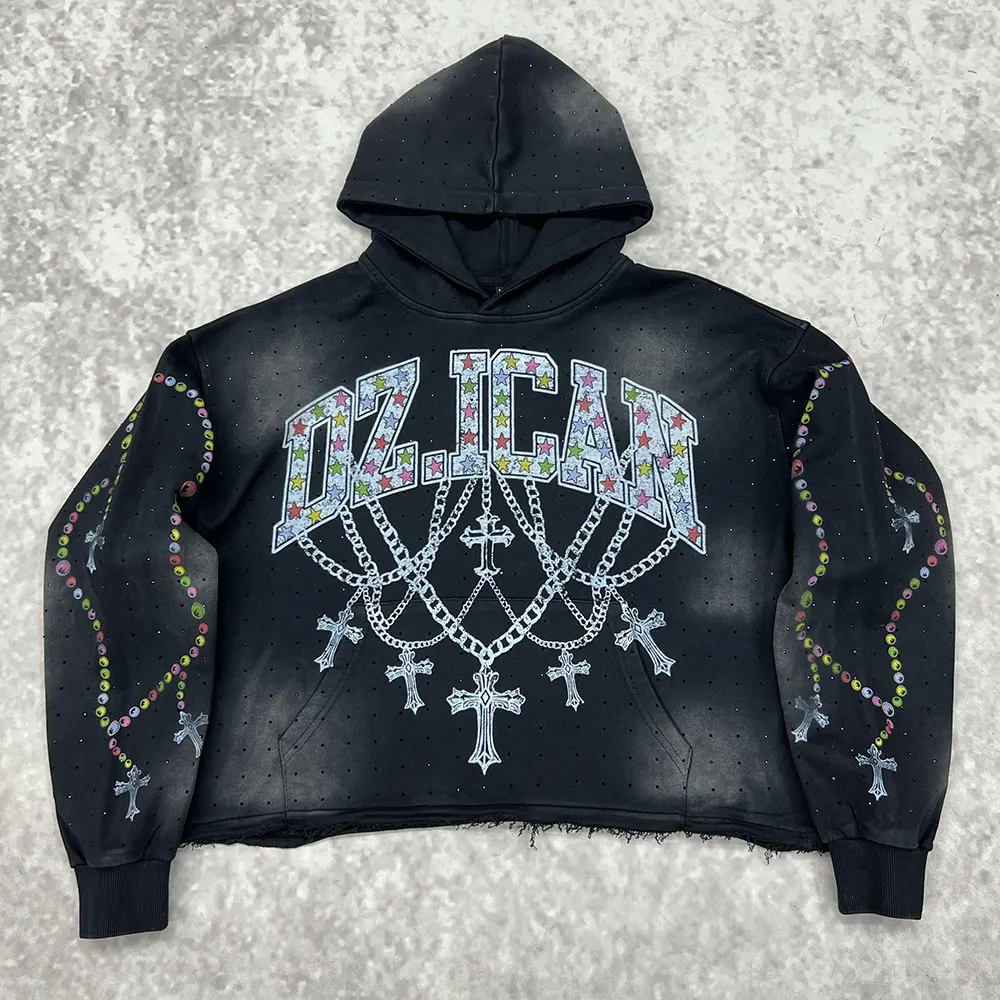
The application of hot-melt adhesives in textiles is the core technology that ensures rhinestones are securely attached without affecting the fabric’s feel.
Market Analysis: Beyond the Hype
The resurgence of rhinestone and embellished apparel is driven by a convergence of cultural forces: the Y2K aesthetic’s maximalism, the “dopamine dressing” phenomenon, and the power of social media where visual impact translates directly to engagement. For a brand, this isn’t about selling a single hoodie; it’s about offering a customizable experience that fans are willing to pay a premium for. The successful brands in this space understand that the product is a canvas for identity, which is why flexibility in design and a reliable, high-quality finish are non-negotiable.
The Manufacturing Deep Dive: Where Success or Failure is Sealed
The central challenge of a rhinestone hoodie lies in the marriage of a soft, flexible fabric with a rigid, decorative element. How this union is engineered determines everything from cost to customer satisfaction (and return rates).
1. The Adhesion Arsenal: Methods Compared
Choosing the right application method is the first critical decision. Each has distinct implications for design, cost, and durability.
| Method | Process Description | Best For | Durability & Wash Test | Cost & MOQ Consideration |
|---|---|---|---|---|
| Heat Transfer/Vinyl | Pre-set crystals on a vinyl sheet are heat-pressed onto the fabric. | Large, solid blocks of color, simple logos, full-coverage designs. | Good. Can withstand multiple washes but may crack over time with fabric stretch. | Low to Medium. Efficient for larger runs. Lower MOQ feasible with stock patterns. |
| Hot-Fix Rhinestones | Individual stones with a heat-activated adhesive are applied with a specialized wand or automated machine. | Intricate designs, gradients, placements requiring high precision. | Excellent. Each stone is bonded directly to the fabric, offering superior resistance to washing and wear. | Medium to High. Labor or machine-intensive. Requires higher skill level. Optimal for low-to-mid MOQ custom work. |
| Hand-Sewn/Embroidery | Stones are sewn on individually or set into an embroidered base. | Luxury or haute couture pieces, where texture and absolute security are paramount. | Superior. The most secure method, but significantly alters the fabric’s drape and hand feel. | Very High. Extremely labor-intensive. Usually reserved for very small batches or premium lines. |
2. The Substrate: The Foundation of Sparkle
The hoodie itself cannot be an afterthought. A high-quality, stable fabric blend is crucial. We recommend a medium to heavyweight cotton-polyester blend (e.g., 350-400gsm). The cotton provides comfort and a good bonding surface, while the polyester adds stability, reduces shrinkage, and helps the garment maintain its shape after multiple washes—preserving the integrity of the rhinestone design.
3. Design for Manufacturability (DFM):
A beautiful sketch can be a production nightmare. Key considerations include:
- Stone Density: Ultra-dense layouts limit fabric stretch and increase the risk of adhesion failure.
- Gradation & Color Blending: Achieving smooth color transitions with hot-fix stones requires expert planning and increases production time.
- Placement on Seams: Applying rhinestones over seams or curves is challenging and may require manual intervention.
The Qianshiwear Advantage: From Concept to Reliable Bulk

Following ASTM international textile care labeling standards (such as the D5489 guidelines) for washing is crucial to extending product lifespan.
At Qianshiwear, we specialize in transforming your rhinestone hoodie vision into a consistently excellent product. Our process is built to mitigate the risks inherent in this category:
- Technical Prototyping: We don’t just make a sample; we create a production-ready prototype that tests adhesion, wash durability, and fabric compatibility. We provide a detailed care label recommendation based on this test.
- Cost-Transparent Scaling: We provide a clear breakdown of costs—fabric, stones (SS10, SS16, SS20, etc.), labor, and overhead—so you understand your margin structure from the first 50-piece order to a 500-piece run.
- Dedicated Low-MOQ Lines: We operate production lines optimized for the agility required by small-batch production, ensuring your custom order receives the same attention to detail as a large run.
- In-House Quality Control (QC): Every batch undergoes rigorous inspection for stone alignment, adhesive integrity, and overall construction before shipment.

FAQ: For Brands Considering Rhinestone Hoodie
Q: What is a realistic Minimum Order Quantity (MOQ) for a custom rhinestone hoodie design?
A: For a fully custom design using hot-fix stones, a competitive and feasible MOQ starts at 50-100 pieces. This allows for efficient sampling and batch production while keeping your initial investment and risk manageable.
Q: How many washes can a well-made rhinestone hoodie withstand?
A: A hoodie produced with proper hot-fix application on a suitable fabric blend should comfortably withstand 20-30+ gentle wash cycles (inside out, cold water, air dry) with minimal stone loss. This is a key metric we validate during our prototyping phase.
Q: How do you handle color matching for custom rhinestone colors?
A: We work with suppliers who provide a wide range of Swarovski®-equivalent crystal colors. You can select from standard swatches or provide a Pantone code for a close match. We’ll provide physical stone samples for approval before production.
Q: What’s the typical timeline from final approved design to delivery?
A: For a standard order of 100-200 units, the timeline is approximately 5-7 weeks: 7-10 days for final sample approval, 3-4 weeks for bulk production, and 1-2 weeks for shipping. Rush options may be available.
Conclusion: Partner for Precision, Not Just Production
The rhinestone hoodie trend is a test of a brand’s operational sophistication. It demands a manufacturing partner who views each order as a collaborative engineering project, not just a cut-and-sew job. Success is measured in compliments that last long after the party ends and return rates that stay near zero.
Ready to engineer your brand’s standout piece? Explore our dedicated manufacturing capabilities for Custom Rhinestone Hoodies and contact our team for a transparent consultation on your specific design, target cost, and timeline. Let’s build something that shines—in every sense of the word.











